Pennsylvania Historical and Museum Commission
The Pennsylvania Historical and Museum Commission, the Commonwealth’s official
history agency, is responsible for preserving and maintaining elements of
historic and cultural interest to the citizens of Pennsylvania. The Commission’s
work includes the management of the Pennsylvania State Archives, archaeology,
historic preservation and the promotion of educational programs focused on the
state’s history. In addition, the Commission administers the 26 historic sites
and museums on the Pennsylvania Trail of History which includes the Ephrata
Cloister. For additional information about the Pennsylvania Historical and
Museum Commission consult the web site at
www.phmc.state.pa.us.
Back to top
Ephrata Cloister Associates
The Ephrata Cloister Associates, incorporated in 1958, is a non-profit
organization composed of interested persons who are dedicated to the continued
preservation and promotion of the Ephrata Cloister through the sponsorship of
special activities such as the Ephrata Cloister Chorus, the Student Historians
program, the Back to the Cloister Fund which helps to return original artifacts
to the site, and educational programs for special audiences. The Associates also
maintain The Museum Store at Ephrata Cloister which specializes in Cloister
related books, gifts and hand-crafted items.
Back to top
Hours
The Ephrata Cloister is open Monday through Saturday from 9:00 a.m. to 5:00
p.m. and on Sunday from noon until 5:00 p.m. The historic site is closed on
Monday in January and February, and on Easter, Veteran’s Day, Thanksgiving and
the day after Thanksgiving, Christmas, and New Year’s Day.
Guided tours are offered daily and are the only way to see the two main
structures. Additional buildings are open for self-guided tours. The last tour
of the day begins at 4:00 p.m.
Back to top
Admission
Admission to the Ephrata Cloister is $7.00 for adults, $6.50 for senior
citizens and 60 and above, and $5.00 for youth ages 6 – 17. Children under age 6
are admitted free. Some special programs may have additional costs.
Back to top
Location
The Ephrata Cloister is located mid-way between Lancaster and Reading in the
Borough of Ephrata. The entrance to the historic site is on Route 322 at the
intersection with Route 272.
Back to top
Time Line
1691 Conrad Beissel, founder of Ephrata Cloister is born in Eberbach,
Germany.
1720 Beissel comes to America and eventually settles in Lancaster County.
1732 Beissel leaves his friends near Lancaster to pursue a life of solitude.
This is the start of the Ephrata Cloister.
1741 Ephrata Cloister begins to develop industries of milling and printing
1740s-1750s Ephrata Cloister is at its peak with about 80 celibate members and an
additional 200 married members. The community becomes a center for the creation
of art, music and printing. Significant buildings, including the surviving
dormitory and meetinghouse are built.
1768 Conrad Beissel dies and the community begins to decline
1777 A military hospital is established at Ephrata by the American Army in the
Revolutionary War
1813 Last celibate member dies; the remaining married members for the German
Seventh Day Baptist Church
1934 The congregation of the German Seventh Day Baptist Church at Ephrata is
dissolved
1941 The Commonwealth of Pennsylvania acquires the historic site and begins
restoration.
Back to top
Story Ideas
With more than 300 years of history to draw from, stories abound at the
Ephrata Cloister. Some of the historic community’s distinctive features such as
art, music, architecture, printing, and a disciplined daily life, are just the
springboard for stories to captivate and educate audiences with the riches of
Pennsylvania’s history.
Write On: Artwork at the Ephrata Cloister
Have you ever tried to write with a quill pen? It isn’t easy. That’s what makes
the artwork of the Ephrata Cloister all the more amazing. Using quills, brushes
and ink the members of the religious community expressed their devotion in a
Germanic form of calligraphy known as Frakturschriften or “broken writing.” The
intricate penmanship was used to inscribe books and make large posters for
exhibit in the meetinghouses. Additionally, the writings were decorated with
finely detailed drawings of birds, people, and numerous imaginative flowers.
This style of artwork was first introduced to America at the Ephrata Cloister,
and the work created here has never been equaled. See for yourself on a visit to
the historic site.
Committed to Print: Printing at the Ephrata Cloister
In an age of computers and desktop publishing, it’s hard to imagine creating
books by hand, one page at a time. For the Brothers of the Ephrata Cloister,
publishing books was just part of their daily work. Using the ink they made with
the paper from their paper mill, the Ephrata Cloister produced nearly 125
different works during the last half of the 18th-century. Included in the
assortment of religious tracts and hymnals printed for themselves, the
community’s press also issued a wide array of titles for neighbors including a
protest against slavery printed for local Quakers, a prayer book for Lancaster’s
Episcopal congregation, blank deed forms for land in nearby towns, and for the
Mennonites, 1500 page Martyrs Mirror, the largest book printed in America before
the Revolutionary War. Today publications from Ephrata are valued treasures
found in museums and libraries around the world. Discover how a community on
Pennsylvania’s early frontier created a complete publishing center with an
international reputation.
Music in the Air: Music at the Ephrata Cloister
Your music teacher would never tell you to sing with your head bowed and your
mouth almost closed—unless your teacher was Conrad Beissel, founder of the
Ephrata Cloister. This singing method was just part of distinctive sound which
could be heard at the historic community in the mid-1700s. Members of the
religious society created over one thousand hymns using the rules of composition
developed by Beissel. No instruments were permitted, and a strict diet was
prescribed to help develop the voice. All together, the rules of Ephrata music
must have worked, for visitors who heard the Brothers and Sisters perform
described the sound as heavenly. Today, the Ephrata Cloister Chorus continues to
preserve and perform this captivating music. After hearing it, you too may agree
with one 18th-century visitor who said it was music that “thrilled to the very
soul.”
Colonial Skyscrapers: Architecture at the Ephrata Cloister
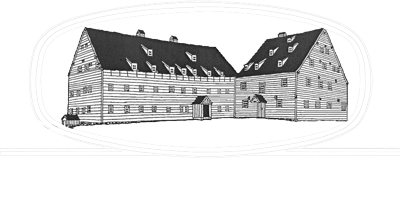
In a time when most people still lived in log homes, a five-story building on
the edge of Pennsylvania’s early frontier was quite an impressive site. It was
all the more amazing when you consider that the members of the Ephrata Cloister
built eight similar buildings in the span of ten years starting in 1735. Using
the construction traditions of their Germanic homeland, these buildings served
as worship halls and dormitories for the celibate community. Along with these
steep roofed buildings were mills, workshops and smaller homes. All total, their
community was comprised of about 50 structures, all with a distinctive German
style. Today, nine of these early buildings have been preserved and provide a
stage on which to explore part of Penn’s “Holy Experiment.”
Testing the Limits of Faith: Daily Life at the Ephrata Cloister
Food, clothing, shelter—these are universal concerns that every early American
settler had to face. While the buildings of the Ephrata Cloister differed only
in their massive size when compared to other Germanic style buildings in
Lancaster County during the 1700s, the life lived in these homes was far
different. Disciplined daily schedules for the celibate members of the religious
community included hours for work and prayer. A long white robe was the
distinctive style of dress for the Brothers and Sisters, and combined with
single meal served each evening, members had a pale and gaunt appearance. Their
six hours of nightly rest was broken by a midnight worship service, and their
time for sleep was spent on a wooden bench with a block of wood for a pillow.
These actions, however, were only the outward expressions of a deep and complex
inner faith shared by members of this community. During a visit to the Ephrata
Cloister, modern day guests can explore this unique way of life which was part
of Pennsylvania’s early history.
Additional ideas:
Revolutionary War Hospital at the Cloister
Revolutionary War Memorial at the Cloister
Restoration of the Cloister, 1941-1960
The Ephrata Cloister Chorus
Old Legends at the Cloister
Back to top
News Releases
Building History: Making and Saving Historic Architecture
“Utter darkness and mystery” is how one reporter described the historic
buildings of the Ephrata Cloister when he visited more than a century ago. In
his day, the large structures covered with wooden siding and dotted with small
windows, were already more than 140 years old. As mysterious as they might be,
today these buildings stand among the most outstanding examples of architecture
to survive from early America. And they’re ready to give up their secrets. Stone
walls laced with timbers, windows without putty, and shingles attached with a
single nail are just some of the features of the program, Building History:
Making and Saving Historic Architecture, to be held at the Ephrata Cloister on
June 16 and 17, 2007. This two-day event will showcase the ways which early
settlers used to build their homes, and the efforts used today to save these
treasures. The program will run from 10:00 a.m. to 4:00 p.m. each day. Admission
is $12.00 for adults, $10 for senior citizens age 60 and above, and $6.00 for
youth ages 6-17.
“Some of these buildings were like skyscrapers in the days when they were
built,” says Toni Collins, historic site administrator. Now the five-story
meetinghouse and it’s neighboring four-story dormitory dominate the landscape of
the historic site, and serve as a backdrop for craftsmen who will demonstrate
historic building techniques. Timber framing, shingle making, and stone cutting
are just some of the demonstrations scheduled for the event. In addition,
presentations throughout the days will provide information about preserving
historic structures and advice for owners of old houses. Tours of un-restored
portions of the Cloister buildings, hands-on activities, and special exhibits
will also help visitors explore the buildings of early Pennsylvania German
settlers. “Understanding how these treasures were made is one part of the story,
learning how to save them for the future is just as important,” adds Collins.
Ephrata Cloister, founded in 1732, was a protestant monastic community of
celibate Brothers and Sisters supported by a married congregation who lived near
the settlement. Members, mostly German immigrants, sought spiritual goals rather
than earthly rewards and chose Saturday as their main day of worship. At its
zenith in the 1750s and 1750s, the congregation numbered nearly 300 people.
Housed in impressive Germanic-style buildings, the lifestyle of the celibate
members was characterized by strict discipline and self-denial. They became
known for their self-composed music, Germanic calligraphy called
Frakturschriften, and printing. Following the death of the last celibate member
in 1813, the remaining married congregation formed the German Seventh Day
Baptist Church. Members continued to live and worship at the Cloister until
1934. In 1941 the Commonwealth of Pennsylvania acquired the surviving elements
of the historic site and began a program of restoration and interpretation.
Today, nine original buildings are part of a 28-acre complex open for visitors.
The Ephrata Cloister Associates, a private, non-profit membership group,
provides support for the continued preservation and educational programs at the
historic site. The Associates operate The Museum Store at Ephrata Cloister, a
source for books, note cards, prints, handmade crafts, and fine gifts.
The Ephrata Cloister is located in the Borough of Ephrata at 632 West Main
Street (Route 322) at the intersection with Route 272. For more information
about the Building History program, please call the Ephrata Cloister at (717)
733-6600. Persons with disabilities who need special assistance or accommodation
should call in advance to discuss their needs.
March 20, 2007 Contact: Michael Showalter
Back to top
Ephrata Cloister632 West Main Street, Ephrata, PA 17522 Telephone (717) 733-6600 Fax: (717) 733-4364
ra-ephratacloister@state.pa.us