
![]() |
||
|
![]() |
|
|
After spending a year in Germantown, just outside Philadelphia, Beissel moved to the Conestoga area, just east of present day Lancaster, Pennsylvania. There he affiliated with the Brethren, an Anabaptist group with offered admission to the faith to those individuals who had reached maturity. In 1724 Beissel was appointed leader of the newly formed Conestoga Brethren Congregation. His radical ideas of Saturday worship and promotion of celibacy soon caused a split within the congregation, and in 1728 Beissel withdrew his membership in the church. His charismatic personality continued to attract followers until 1732 when he left the Conestoga and sought the hermit's life along the banks of the Cocalico Creek in northern Lancaster County. Soon after his move to the Cocalico region, Beissel was followed by like-minded men and women who wished to follow his teachings.
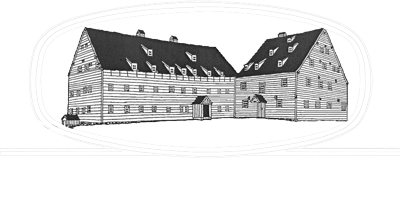
During the period from 1735 to 1746 the community constructed no less than eight major structures, dormitories or meetinghouses, in addition to a number of smaller dwellings, workshops, and mills. Not all of this was done without internal discord. The most dramatic was the challenge to leadership posed by Israel Eckerlin, Prior of the Brotherhood. The Eckerlin controversy came to a head in 1745 with Eckerlin’s expulsion from Ephrata, but is was not the only note of conflict in the community’s long history. With the death of Beissel in 1768 the society quickly declined. Peter Miller, successor to Beissel, recognized that the monastic life was no longer attractive to new generations. He wrote to Benjamin Franklin saying, “the mind of Americans is bent another way.” By 1813 the last of the celibate members died, and the following year the remaining members of the married congregation formed the German Seventh Day Baptist Church. Poorer members of the Church moved into many of the original buildings on the Cloister property and altered the spaces to suit their needs. With these new residents came bits of furniture and household items; however they also made use of the furnishings that remained in the buildings. In many cases 18th-century furniture was given a coat of paint, cut down to fit a space, or repaired with disregard to original construction methods or materials. By 1929 the remaining church members living at the Cloister entered into a disagreement with each other on the disposition of the site and its artifacts. The members took legal action against one another, and in 1934 the court system revoked the incorporation charter for the Church at Ephrata. The property was placed under the care of a court appointed receiver, who in 1941, sold the remaining 28 acres of the historic site to the Commonwealth of Pennsylvania. Restoration on the nine surviving original buildings began immediately, headed by architect G. Edwin Brumbaugh. Brumbaugh left the project in 1960 and most interior spaces were restored by architect John Heyl. Today the National Historic Landmark is administered by the Pennsylvania Historical and Museum Commission. Daily tours, special programs, and on-going research continue to inform and educate visitors to the site about Ephrata’s surviving legacy and the people who built it. |
||
632 West Main Street, Ephrata, PA 17522 Telephone (717) 733-6600 Fax: (717) 733-4364
Home History Virtual Tour Planning a Visit Research Events Online Store Members Volunteer Opportunities Rentals Educational Programs Guest Book | ||